HARBORLINE TRADING

Guides for buying kitchen supplies without the usual mistakes

Three short reads. Each one covers something we see owners get wrong, and what to do instead.

  1. 01How to size an opening smallwares order from your menu
  2. 02Takeout packaging in California: what to check before you reorder
  3. 03Setting par levels for a weekly restock

How to size an opening smallwares order from your menu

Smallwares are the things in a kitchen you can pick up and carry: pans, knives, tongs, food pans, plates. Most new owners buy them from a catalog by category. That's how you end up with forty sauté pans and not enough 1/3 pans for the line.

Start from the menu instead. Go dish by dish and ask three questions. What is it cooked in? What is it held in? What is it served on? A carne asada plate might need a sheet pan for prep, a 1/3 pan on the line, tongs, and a 10" plate. Write that down for every dish, then merge the lists.

Next, use your seat count for anything in the dining room. A simple rule: plates, bowls and glasses at two times your seats, flatware at three times. That covers one turn on the tables, one in the dish pit, and breakage. Busy weekend brunch places often go higher.

For the line, count the wells. Every well in a steam table or cold rail needs a pan in it and a full set of spares in the walk-in. So a cold rail with six 1/3 pans really means twelve, plus lids.

Check your power before you pick countertop equipment. Many countertop induction ranges, like the 1800 W models, run on a normal 120 V outlet. Higher-power units need 208–240 V, which a lot of small kitchens don't have at the counter. Induction also only works with pans a magnet sticks to, so your sauté pans have to be induction-ready.

Last, leave room. Order the basics for opening week, then add after two weeks of real service. You'll know which station runs short. When you send us your menu, this is the method we use to build your list, and every quantity comes with a note so you can disagree with it.
Takeout packaging in California: what to check before you reorder

Takeout packaging feels like the cheap part of an order. It adds up fast, and in California it also comes with rules. Here are the three things worth checking.

No foam. Since January 1, 2025, California doesn't allow expanded polystyrene (EPS) foodware to be sold or distributed. That's the white foam clamshell, cup and plate. If an old supplier still ships foam, that's a problem for them and a risk for you. Switch to paper, molded fiber, plastic or aluminum.

Utensils only on request. Under AB 1276, restaurants and delivery apps can only hand out single-use utensils, straws and condiment packets when the customer asks. They also can't be bundled together, so a customer must be able to take just a fork. Keep loose cutlery or kits customers can open for one piece, and add a "utensils?" question to your online ordering.

Compare price per piece, delivered. Packaging is sold by the case. To compare suppliers, divide the case price by the pieces in the case, then add the freight. For example, a $45 case of 150 hinged boxes is about $0.30 a box. A cheaper case that ships with a big freight charge can end up costing more per box.

Add up a whole order, too. A box, two portion cups, a napkin and a bag is your real packaging cost per ticket. Know that number before you set takeout prices.

When we quote packaging, every line shows the case price, the pieces per case and the delivery fee, so you can do this math in a minute.

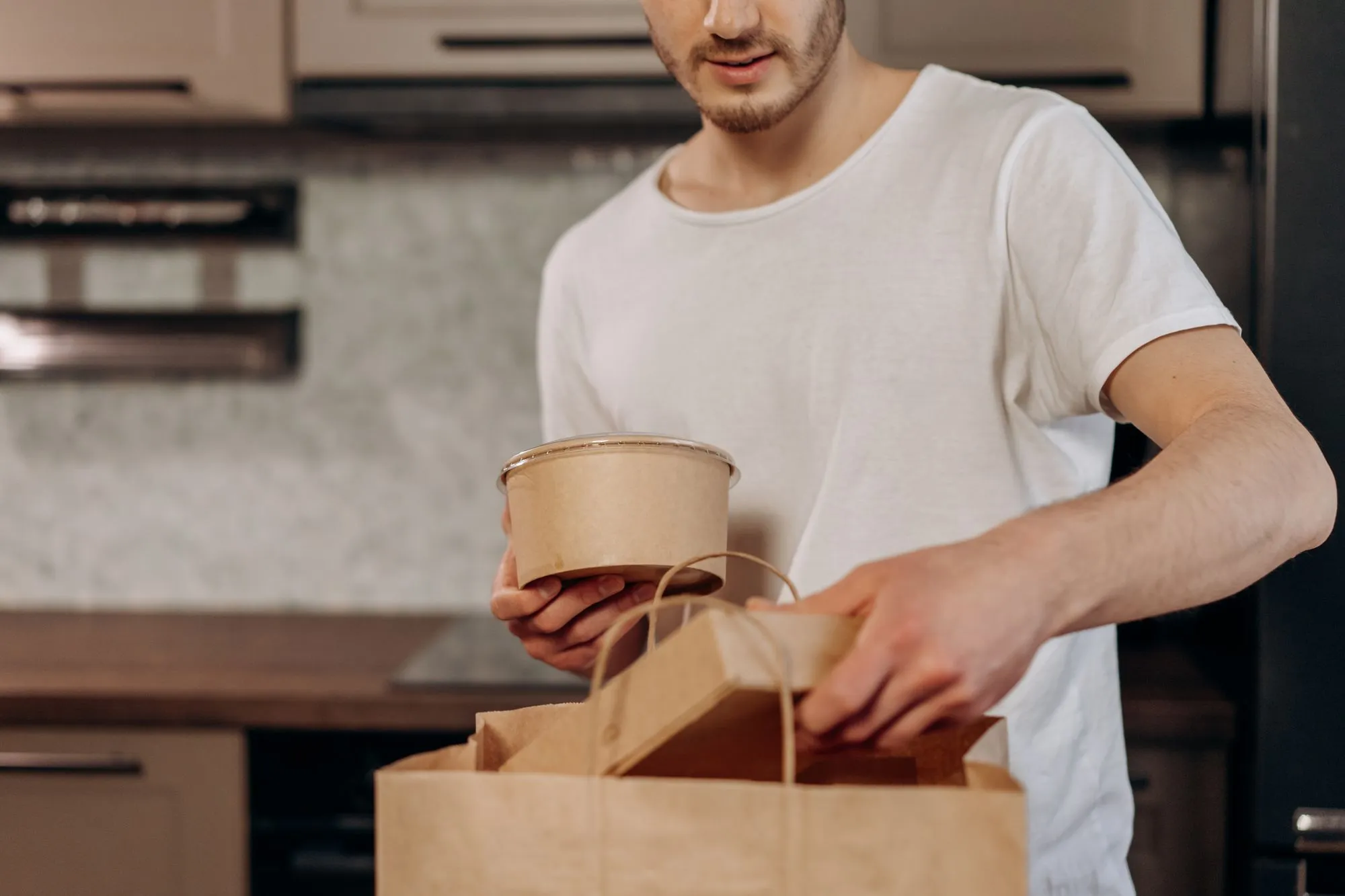
Takeout containers being packed into a paper carryout bag

Setting par levels for a weekly restock

A par level is how much of something you want on the shelf right after a delivery. Set it right and you stop running out, without filling the dry storage with boxes.

Here's an easy way to set one. Look at how much you used in your busiest normal week. Add a cushion of about a quarter for surprises. If you get deliveries every two weeks, double the weekly number first.

Say you go through 2½ cases of soup cups in a busy week. With weekly delivery and a cushion, your par is 3 cases. Before each delivery you count what's left, and we send the difference. If one case is on the shelf, you get two.

Don't set par for everything. Pick the 15 to 25 items you reorder all the time: your main takeout boxes, cups and lids, gloves, trash liners, foil, film, sanitizer and test strips. Leave one-off items like a new ladle for when you need them.

Sanitizer needs a little extra thought. The health inspector will ask you to test your sanitizer with strips. California's food code sets the levels: for example, chlorine at 100 ppm for at least 30 seconds, or quaternary ammonium at 200 ppm for at least 1 minute, used the way the label says. Test strips have to match the chemical you use, and they run out quietly. Put them on your par list.

Look at your pars again every season. Summer patio months, holidays and catering season change your numbers. You can change amounts before any delivery, so the list is a starting point, not a contract.

Set up a standing list